


Since its inception, Radio Free Asia has been a crucial source of independent news in Myanmar where the dominant military has brooked no criticism, even during the years when democracy was taking root.
First by shortwave radio and then primarily via social media, RFA Burmese has, throughout it all, given a first take on every twist and turn in the nation’s turbulent modern history. It has reported on the struggle for freedom, military crackdowns and the current civil war.
The coverage has derived its impact from its audience who have been among the most enthusiastic consumers of RFA in Asia. The Burmese service has always put the testimony and personal stories of regular citizens, its core audience, at the center of its reportinthe
Saffron Revolution 2007
RFA Burmese provided round-the-clock coverage of the biggest democracy protests in two decades that were led by Buddhist monks, in a show of defiance against Myanmar’s military rulers.
RFA reporting on the Saffron Revolution, broadcast by shortwave radio, demonstrated the network’s ability to tap sources inside the country and document violence inflicted on protesters. That included revealing accounts from detainees of torture and other abuses, and a military truck plowing into civilians. RFA’s coverage won a New York Festivals gold award for radio broadcasting.
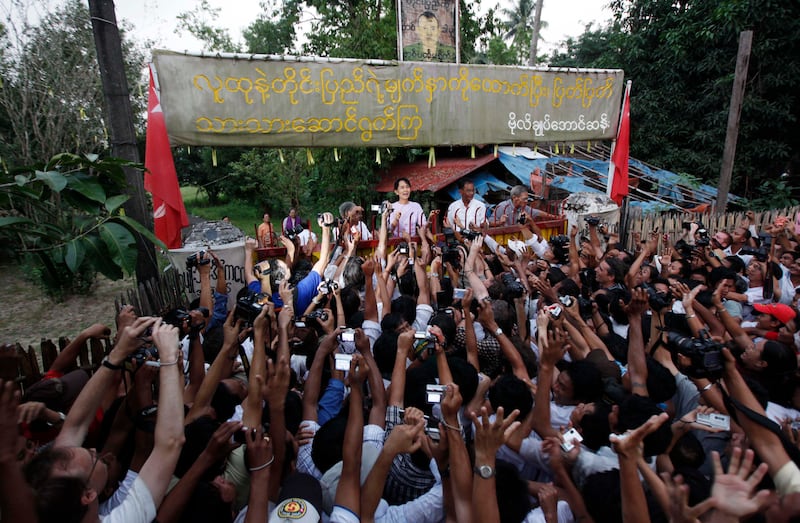
Aung San Suu Kyi after her 2010 release
A day after democracy leader Aung San Suu Kyi was freed from 15 years of on-and-off house arrest, she was interviewed by RFA Burmese and called for dialogue with the ruling junta. She also confided that during her house arrest she’d tuned into RFA. “For RFA, as well as other news agencies, I listen to political news as a duty,” she said.
Her release ushered in a decade of reform that culminated in Suu Kyi becoming the nation’s civilian leader; but by February 2021 she was back under arrest when the military grabbed power in a coup.

